
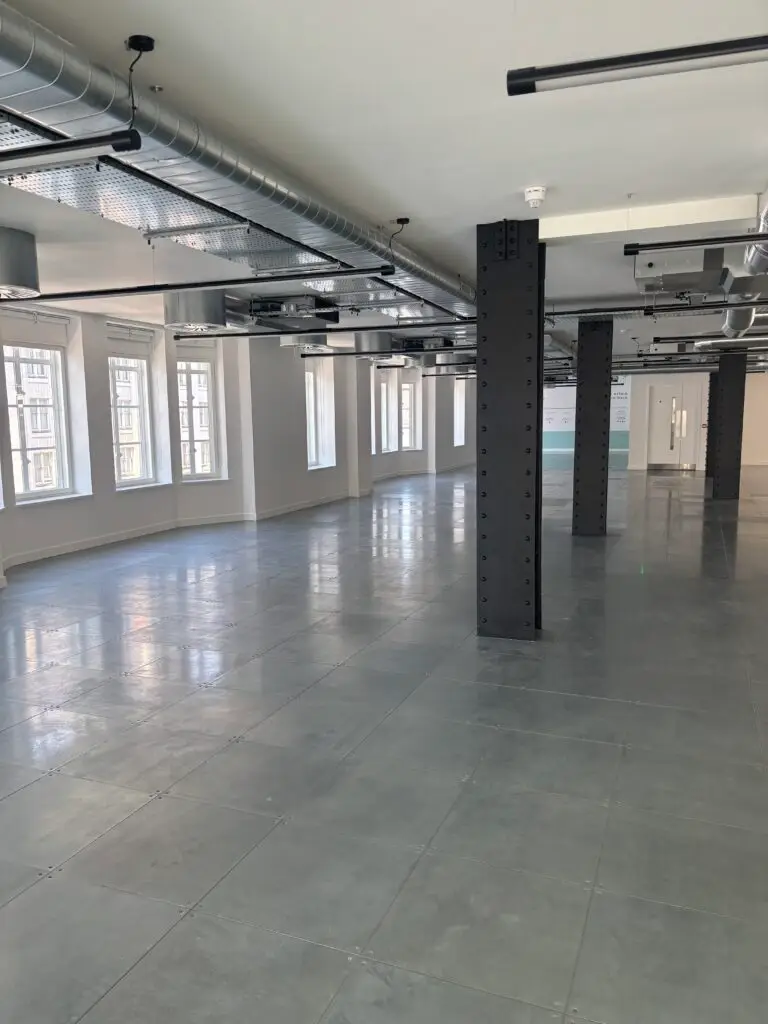
Most London tenants underestimate how long an office lease-end runs. Partitions come down, ceilings are made good, carpet tiles are replaced, the space is cleaned, the landlord’s surveyor walks the floor, and a signed handover is issued. Done well, the full cycle takes twelve to eighteen months from first planning to final sign-off. Done late, it collapses into a rushed, expensive scramble that almost always ends in the landlord’s contractor finishing the job — at a steep mark-up — or a padded cash settlement that closes nothing cleanly.
This timeline sets out what to do, when to do it, and why each step matters. It is written for commercial tenants across central London — from a 3,000 sq ft floor in Shoreditch to a 30,000 sq ft headquarters in Canary Wharf — and is based on the work we deliver every week at London Dilaps Ltd.
Why the Timeline Matters More Than Most Tenants Expect
Two things drive the timeline: the legal liability you carry under the lease, and the physical reality of getting works delivered inside a managed London building. The lease sets the obligation to return the space in a defined condition. The building sets the access windows, the out-of-hours restrictions, the goods-lift bookings and the permit approvals that every trade has to work around.
Leave the programme too late and you lose two kinds of leverage at once. You lose the ability to scope the works properly against the schedule of dilapidations, which is the surveyor’s formal list of what needs reinstating. And you lose competitive tension in the supply chain, because a specialist strip-out and Cat A reinstatement contractor cannot compress twelve weeks of sequenced works into three. The net effect is that tenants who start late end up negotiating from a position of weakness — often with a landlord-padded cash settlement as their only exit.
A Typical 18-Month Dilapidations Timeline
Every lease is different, but the shape of the programme below holds for the overwhelming majority of London office lease-ends. Use it as a planning baseline; adjust it for your break clause, lease expiry date and the size and complexity of your fit-out.
18 to 12 Months Before Lease End — Review and Plan
Start with the lease itself. Read the repair clause, the yield-up clause, any licence for alterations, and the Schedule of Condition if one exists. These four documents define your liability. A specialist contractor — or a tenant-side dilapidations surveyor — can translate them into a scope of physical works and a realistic budget per square foot. At this stage you are not appointing anyone; you are building an internal view of the cost, risk and programme well before the landlord’s surveyor arrives.
12 to 9 Months Before — Scope the Works and Get a Baseline Price
Now invite a specialist dilapidations contractor to walk the floor with you. A competent contractor will produce a line-by-line estimate covering strip-out, partition removal, Cat A reinstatement, decorations, carpet, ceiling make-good and end-of-lease cleaning. This baseline number is critical. When the landlord’s schedule lands, you will have an independent figure to compare it against — which is how you avoid negotiating blind.
9 to 6 Months Before — The Schedule of Dilapidations Arrives
The landlord’s surveyor typically issues a terminal schedule of dilapidations between nine and six months before lease expiry. Review it against your baseline estimate. Expect the schedule’s cash figure to be higher than the true cost of works: landlord-prepared numbers routinely include contingency, supervisor fees, administrative uplifts and a loss-of-rent allowance during the works. Your job is not to argue the figure down; your job is to get the works booked so the liability is closed on handover, not left open as cash.
6 to 3 Months Before — Works On Site
Appoint your contractor, secure goods-lift and out-of-hours slots with the building manager, and start on site. In a typical central London office of 5,000 to 15,000 sq ft, strip-out plus Cat A reinstatement runs six to twelve weeks. Managed buildings in Canary Wharf, the City and the Southbank frequently require night and weekend working because daytime lift access is restricted — bake that into the programme.
3 to 1 Months Before — Snag, Sign-Off and Handover Pack
With works complete, invite the landlord’s surveyor to inspect. Any snags are remedied quickly while your contractor is still mobilised. A clean handover pack — photographs, as-built drawings where relevant, test certificates for any M&E work, and a final end-of-lease clean — closes the file definitively. The signed handover is what ends the liability; without it, the landlord can reopen the conversation later.
Handover Day and the Weeks After
On the day you vacate, the works have already been signed off. There is no cash figure outstanding, no settlement under negotiation, and no risk of a further claim for further losses. The landlord has a re-lettable Cat A floor and you have a closed file. This is the single biggest reason we steer clients toward completing the works rather than settling: a completed lease-end cannot be reopened.
What Happens If You Start Too Late
Tenants who begin planning inside the last three months typically face three compounding problems. First, the specialist contractor market in central London is booked out four to eight weeks ahead, so programme slots are scarce and rushed work attracts a premium. Second, with no independent baseline, there is no leverage against the landlord’s schedule figure. Third, when the works are not physically delivered by lease expiry, the landlord is entitled to appoint their own contractor to complete them — at rates that are consistently 20 to 50 per cent above a direct-to-contractor price.
The result is the worst of both worlds: a higher bill and a liability that drags on. Starting early is the single cheapest decision a tenant can make.
Typical London Costs Across the Timeline
As a planning benchmark for central London, expect £15 to £25 per sq ft for a straightforward office strip-out, and a further £25 to £45 per sq ft for full Cat A reinstatement where the lease requires it. Premium buildings — Canary Wharf towers, listed City buildings, Mayfair period stock — push the upper end. End-of-lease cleaning adds £1 to £3 per sq ft.
A direct-to-contractor programme is consistently cheaper than a landlord-led one for a simple reason: you pay the contractor’s rate, not the landlord’s rate with contingency, supervisor fees, administrative uplifts and a lost-rent allowance stacked on top. On a 5,000 sq ft floor, the saving is routinely £40,000 to £80,000. Across a 20,000 sq ft footprint, it can exceed £250,000. Crucially, you also keep control of specification, quality and programme throughout — three things that are surrendered the moment a cash settlement is agreed.
Two Things London Tenants Routinely Wish They’d Known Earlier
The first is that the schedule of dilapidations is not a bill. It is an opening position prepared by the landlord’s surveyor, drawn from the lease and the licence for alterations, and typically padded with cost assumptions that favour the landlord. Treat it as a scope document, not a demand. Price the works independently, book them in, and complete them. The schedule then falls away at handover because the physical works are signed off — the item-by-item cash figures become irrelevant.
The second is that settlement does not close anything definitively. A cash figure paid to the landlord at lease end does not oblige them to carry out the works, and if further losses crystallise later — lost rent during a void, additional building remedials, or a surveyor’s fees — the conversation can be reopened. Completed works cannot. On the day your contractor hands back a signed-off floor, the liability is extinguished. For that reason alone, the programme above is worth protecting, even when a settlement looks like the path of least resistance.
How Building Type Shifts the Timeline
Canary Wharf towers, City managed estates and Southbank multi-let buildings all impose tighter constraints than a standalone building in Shoreditch or Clerkenwell. Expect booked goods-lift slots, strict out-of-hours requirements, banksman and permit protocols, and longer mobilisation windows. Add two to four weeks onto the programme for these buildings, and plan for night and weekend shifts as part of the base case. Period buildings in Mayfair, Fitzrovia and the City have their own variables — timber floors, listed finishes, narrow stair cores — which can extend strip-out sequencing even where the overall scope is modest.
Your Next Step: A Free On-Site Assessment
London Dilaps Ltd delivers end-of-lease strip-out, Cat A reinstatement, make-good works and end-of-lease cleaning across every London postcode. We hold £5m Public Liability and Employers’ Liability insurance, work nights and weekends around building-manager restrictions, and are equally at home on a single floor in Shoreditch or a 40,000 sq ft Canary Wharf tower floor.
If you are six to twelve months out from lease expiry — or your schedule of dilapidations has just landed — we will walk the floor with you and produce a line-by-line estimate at no cost. Most tenants find the true cost of works comes in well below the landlord’s schedule figure, and that gap is your saving.
Ready to start? Contact London Dilaps for a free assessment and take control of your lease-end on the front foot.
Further reading on londondilaps.com
Office Strip-Out Services in London