
The Complete Guide to Office Dilapidations in London (2026 Edition)
In a hurry? Here’s the summary
Office dilapidations are the repairs, reinstatement and make-good works your lease requires you to complete before handing the space back to your landlord. In London, costs typically run £15–£35 per sq ft, and most claims can be reduced through proper scope review, surveyor negotiation and starting early. Plan 6–12 months out from your lease end or break date, get a specialist contractor’s view alongside your surveyor’s, and don’t accept the served Schedule of Dilapidations at face value — a meaningful share of the items on most schedules can be challenged.
This guide walks through what dilapidations actually are, why London is harder than the rest of the country, what drives the cost, and how to keep your final bill as low as your lease realistically allows.
What are office dilapidations?
Dilapidations are the contractual works a tenant has to complete at the end of a commercial lease — or when exercising a break clause — to return the space in the condition the lease requires. They sit in the repair, decoration, yield-up and reinstatement clauses of your lease, and they typically cover four categories of work:
- Repairs — putting right any damage or wear that goes beyond fair wear and tear
- Reinstatement — removing tenant alterations and putting the space back to base build (often CAT A specification)
- Decoration — repainting, redecorating and refinishing in line with the lease decoration covenant
- Compliance and clean — final clean, M&E recommissioning, statutory testing, and any outstanding compliance items
At lease end (or shortly before), your landlord’s surveyor will usually serve a Schedule of Dilapidations — a line-by-line document listing every item they say needs putting right, with a cost against each. From there, you have three broad options: complete the works yourself, agree a cash settlement (a “dilapidations claim”) in lieu of works, or negotiate a hybrid of the two. Which route makes sense depends on the lease terms, the time you have left, and the scope.
We cover the full process and timeline in our office strip out guide and in our end-of-lease cleaning and make-good guide. If you’ve already received a schedule and you’re trying to work out what to do with it, our page on office dilapidations sets out how we price and review served schedules.
Why dilapidations are tougher in London than elsewhere
We work all over the South East, but London is different. Five things make lease exits in the capital harder than the rest of the country:
Landlord and surveyor experience. The institutional landlords and managing agents that own most of London’s commercial stock — particularly in the City of London, Canary Wharf and the West End — have seen thousands of lease exits. Their schedules are detailed, their specifications are precise, and they know which arguments to push back on.
Building access and working hours. Most central London offices sit inside multi-let buildings with restricted access, out-of-hours-only working windows, goods lift bookings, building permits and tight waste routes. None of that shows up on the schedule, but all of it shows up on the price.
Heritage and protected fabric. Around Bank, Holborn, Mayfair and parts of the South Bank, you’ll find offices inside listed or conservation-area buildings where original fabric can’t legally be touched — even if the schedule says it should be reinstated.
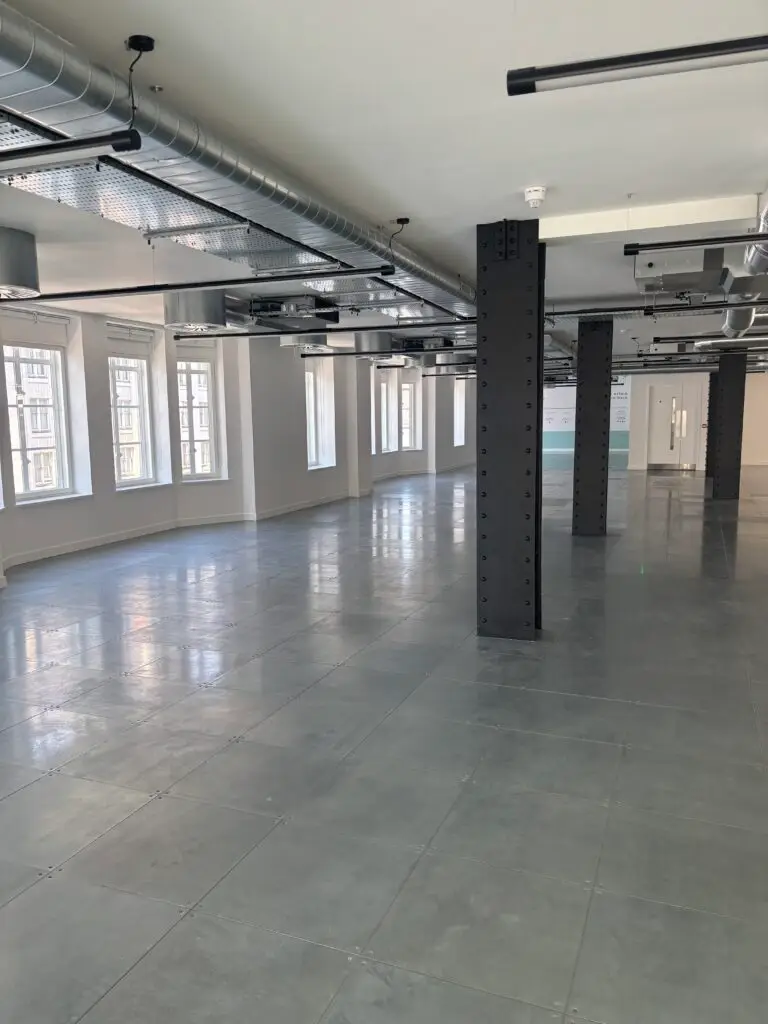
CAT A expectations. Most modern London leases require return to CAT A specification: a clean, open-plan, base-build environment with suspended ceilings, perimeter lighting, raised access flooring and finished decoration, ready for the next tenant to fit out. That’s a higher bar than “leave it tidy.”
Refurbishment cycles are faster. London landlords re-let space quickly. They want the building back ready to go, which means they’re less willing to absorb minor non-compliances than landlords in slower regional markets.
The result: London tenants face larger schedules, less flexibility, and more pressure to deliver on time. Early planning isn’t optional — it’s the single biggest lever you have.
What does it cost?
Dilapidations costs in London in 2026 typically fall between £15 and £35 per sq ft, depending on the size of the office, the condition you’ve left it in, and the scope the landlord requires. A 5,000 sq ft floor therefore lands somewhere between roughly £75,000 and £175,000.
The drivers within that range are:
- Location. Prime central London (City, West End, Mayfair) runs roughly 20–30% above outer zones because of labour rates and access constraints
- Building age and condition. Older buildings are slower to work in and often need more remedial work to pass a landlord inspection
- The volume of tenant alterations. Every partition, kitchenette, feature wall, AV install or bespoke joinery item you’ve added is something that may need stripping out
- Lease specification. A straightforward CAT A reinstatement runs in the £18–£25 per sq ft range; a complex strip-out, M&E and reinstatement programme can reach £30–£40 per sq ft
- Programme pressure. Compressed timelines mean overtime working, premium labour rates, and less flexibility on materials
For a much fuller cost breakdown — including how Section 18 caps work and what professional fees to expect — see our dedicated guide on how much office dilapidations cost in London.
What’s typically on a Schedule of Dilapidations?
Schedules vary, but most London office schedules cover the same broad categories. The work falls into three buckets:
Strip-out items — partitions, kitchenettes, joinery, AV installations, signage, feature walls, tenant-installed flooring, data cabling, floor boxes and any bespoke fit-out elements that weren’t in the original base-build.
CAT A reinstatement items — suspended ceilings, perimeter lighting, raised access flooring, power distribution, fresh decorations, and recommissioning of M&E systems to base-build standard.
Repair, decoration and make-good items — patching, redecorating, replacing damaged ceiling tiles, refinishing floors, repairing door furniture, and the final clean.
Not everything on a schedule is automatically your responsibility. A meaningful proportion of items on most served schedules can be challenged — typically because they’re over-specified, duplicated, outside the tenant’s contractual responsibility under the lease, or covered by an agreed Schedule of Condition from the start of the tenancy. Reviewing the schedule line-by-line against the lease and any Schedule of Condition is the single most valuable step in the whole process.
How to reduce your dilapidations bill
There are five things that consistently move the number down. None of them are tricks — they’re just discipline applied early.
1. Start 6–12 months before lease end
This is the biggest lever, by some distance. Tenants who start planning a year out have time to review their lease properly, get a specialist contractor in to assess the space, take a view on whether to do the works or settle, and negotiate without time pressure. Tenants who start six weeks out end up paying whatever the landlord asks because they have no other option. If your lease end or break date is in 2026, the time to start is now.
2. Get a contractor’s view alongside your surveyor’s
A building surveyor is essential for the lease interpretation and the formal negotiation. But a specialist contractor can tell you what each item on the schedule actually costs to build, which items are over-specified, and whether the landlord’s pricing is in line with the market. The two roles complement each other — and a contractor’s quote based on real London delivery rates is often the most powerful piece of evidence in a settlement discussion.
3. Negotiate properly
Most tenants under-negotiate. Surveyor-to-surveyor negotiation, backed up by a costed scope from a specialist contractor, routinely reduces claims by 20–40%. The landlord’s surveyor expects negotiation — they price the schedule knowing it will be challenged. Settling without challenge means leaving money on the table.
4. Consider doing the works yourself
If you have cash and time, completing the works through your own contractor is often 15–25% cheaper than paying the landlord’s contractor to do them. The landlord doesn’t have to take “money in lieu” — but if your works are demonstrably compliant with the lease specification, most reasonable landlords will accept a delivered programme over a cash settlement.
5. Use a specialist, not a general builder
This matters more than people expect. Generic builders typically don’t know the specifications London landlords work to, can’t read a Schedule of Dilapidations against a lease, and don’t have the relationships with managing agents that make handover walk-rounds smooth. A specialist contractor who does this work week-in, week-out will deliver faster, hit the spec first time, and avoid the small handover disputes that drag on for weeks.
Common questions
When should I start planning? Six to twelve months before your lease end or break date. Twelve months gives you negotiating room; six is the minimum to get works delivered without paying a premium.
What’s the difference between a Schedule of Condition and a Schedule of Dilapidations? A Schedule of Condition is agreed at the start of the lease and records the condition of the space when you took it on — it sets the benchmark you have to return it to. A Schedule of Dilapidations is served at the end of the lease and lists what the landlord says you owe. We cover this in detail in our lease end planning guide.
Do I always have to reinstate to CAT A? No — it depends entirely on your lease. Some leases require return to “the original condition,” some require CAT A, and some allow tenant alterations to remain. Read the reinstatement clauses carefully before assuming.
What happens if I don’t do the works? The landlord can pursue a damages claim through the courts, capped under Section 18 of the Landlord and Tenant Act 1927 by the actual loss in the building’s value. They can also withhold deposits, refuse to release guarantees, and in some cases pursue you for holding over costs.
Can I negotiate the schedule down? Yes — and you should. Most schedules contain items that are over-specified, duplicated, or outside your contractual obligation. A surveyor-led negotiation backed by a specialist contractor’s quote routinely reduces claims meaningfully.
How long does the work take? A small office (under 2,000 sq ft) can be completed in 1–2 weeks. A typical 5,000–10,000 sq ft floor takes 4–8 weeks depending on scope. Complex multi-floor reinstatements can run 10–12 weeks or longer.
Next steps
If your lease is ending in the next twelve months, the most useful thing you can do today is get a clear view of what your obligations actually are — before the landlord’s surveyor sets the agenda for you. A specialist contractor’s site walk-through and indicative cost takes about an hour and gives you the numbers you need to decide whether to plan for works, plan for settlement, or both.
London Dilaps Ltd provides free, no-obligation dilapidations assessments for offices across London. We’ll review your space against your lease obligations and give you a clear, fixed-price view of what the realistic exposure looks like — so you can plan your lease exit with hard numbers instead of guesses.