
Last updated:
Ask ten London office tenants to define Category A and Category B fit-out and you will get ten different answers. The terms get used interchangeably in brochures, agents’ listings and even some lease documents — yet at the end of a lease they carry very different meanings, and the distinction drives tens or hundreds of thousands of pounds of reinstatement liability. This guide sets out what Cat A and Cat B actually are, what each spec typically includes in London, and why the difference becomes sharply material the moment your lease-end approaches. For a wider look at who pays for what at lease end, see who pays for dilapidations.
The Short Answer
Cat A is the landlord’s finish — the space as it was handed to the first tenant, ready to be occupied but not yet customised. Cat B is the tenant’s fit-out on top — the branded, functional, personalised office that actually reflects your business. At lease end, the near-universal obligation is to remove Cat B and return the space back to Cat A. Understanding exactly what each spec covers is therefore the starting point for scoping the works you will need to carry out.
What Is a Category A Fit-Out?
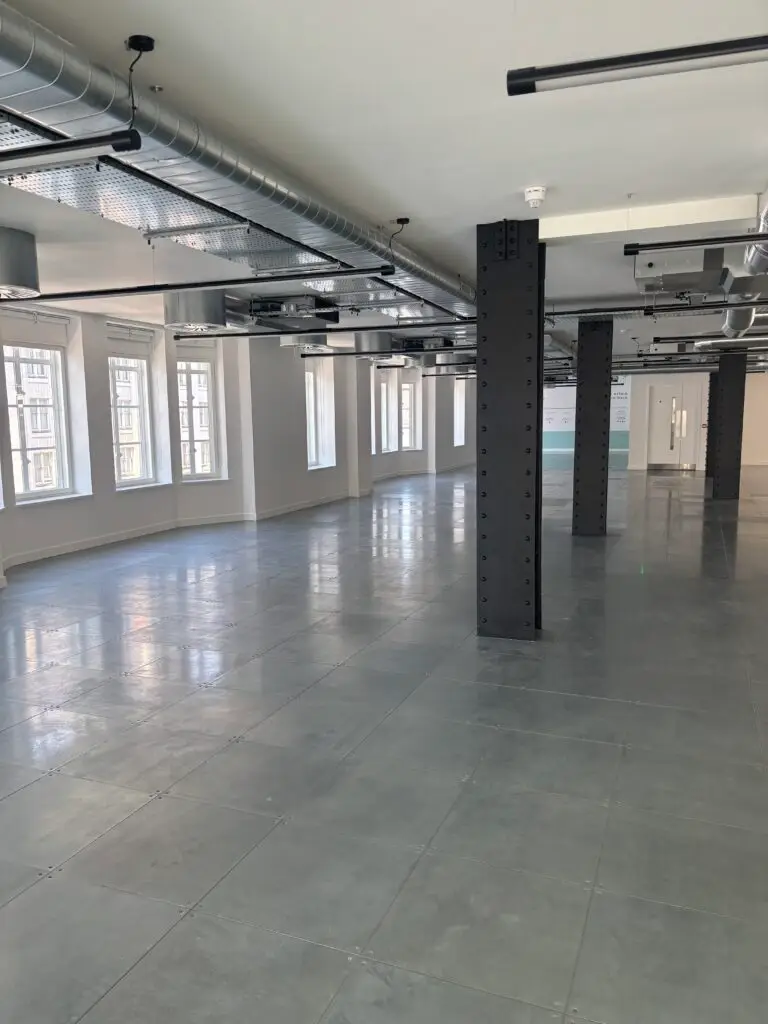
A Category A fit-out is a developer- or landlord-funded base build designed to make the floor ready to let. It is a blank-canvas finish, not a ready-to-occupy office. The building’s mechanical and electrical services are in place, the floors and ceilings are complete, and the space is decorated to a neutral standard — but there are no partitions, no tea-points, no branded reception, no cable management for desks, no data cabling serving a specific layout.
A typical Cat A specification in central London includes:
- Raised access flooring with new carpet tiles or vinyl to landlord spec
- Suspended ceiling grid with standard acoustic or metal tiles
- Perimeter and central lighting to a uniform lux level — commonly LED panels
- Fully commissioned VRF or chilled-beam HVAC serving the entire floorplate
- Small power and basic containment at perimeter and core
- Decorated walls and columns to a neutral white or off-white finish
- Fire alarm, sprinklers and life-safety systems commissioned to the whole floor
- WCs, showers and kitchens in the core (landlord-controlled)
Cat A is, in effect, the condition the landlord will want the floor returned to at lease end so the next tenant can walk in, design a fit-out and start again.
What Is a Category B Fit-Out?
Category B is everything that turns a Cat A shell into a working office for a specific occupier. It is the layer of fit-out funded and installed by the tenant — either directly or through a landlord-funded capital contribution — and it is always designed around the tenant’s brand, headcount, working patterns and technology.
Cat B typically includes:
- Meeting-room and office partitioning — stud walls, glazed screens, acoustic pods
- Reception and feature walls, branded joinery, bespoke signage
- Tea-points, coffee bars, breakout kitchens and associated plumbing
- Desks, storage, seating, soft furnishings and AV equipment
- Feature lighting — pendants, track, accent and architectural fittings
- Additional small power, floor boxes and data cabling for desk layouts
- Feature ceilings, exposed-service zones, bulkheads and rafts
- Flooring changes — carpet replacement, timber planks, resin or feature vinyl
- Breakout rooms, phone booths and modular furniture
Cat B is where a business’s identity shows up — and because it is bespoke, it is also where most of the strip-out work sits at lease end. For what the strip-out stage costs, see our breakdown of office strip-out costs.
Why the Distinction Matters at Lease End
The average commercial lease requires the tenant to yield up the premises in the condition they were delivered, or — where a licence for alterations has been granted — in the condition required by that licence. In practice, that almost always means stripping out the Cat B fit-out and reinstating the Cat A base build. This is the formal process known as Cat A reinstatement. The best protection is a schedule of condition, agreed at the start of the lease, which records the state of the space so you are not later held to a better standard than you received.
The schedule of dilapidations issued by the landlord’s surveyor is effectively a line-by-line record of the reinstatement works: every partition to be removed, every ceiling tile to be replaced, every carpet tile to be renewed, every kitchen to be stripped. Without clarity on the original Cat A spec, tenants find themselves arguing scope rather than scoping works — and that is how budgets slip, programmes slide and landlord-padded cash settlements start to look like the path of least resistance.
Typical Cat A Reinstatement Scope for a London Office
For a typical 5,000 to 15,000 sq ft central London floor being returned to Cat A, the reinstatement package usually covers:
- Complete removal of tenant partitions, glazing, pods and joinery
- Removal of all tenant-installed carpets, floor boxes and data cabling
- Replacement carpet tiles or vinyl to match the original landlord specification
- Suspended ceiling grid realignment, missing or damaged tiles replaced
- Lighting stripped back to landlord-spec layout; feature lighting removed
- Decorations throughout to a uniform Cat A finish
- Mechanical and electrical systems returned to perimeter-supply configuration
- Kitchens, tea-points and feature WCs stripped and walls made good
- End-of-lease clean, all finishes left handover-ready
What Cat A Reinstatement Typically Costs in London
As a planning benchmark, Cat A reinstatement in central London usually runs £25 to £45 per sq ft, with a strip-out of the Cat B fit-out adding £15 to £25 per sq ft on top. Premium buildings — Canary Wharf towers, listed City stock, Mayfair period assets — push toward the upper end. The combined figure for a full lease-end package on a 10,000 sq ft floor therefore ranges from roughly £400,000 for a simple, open-plan fit-out up to £800,000 or more for a heavily customised fit-out in a managed building.
These numbers sound substantial until they are set against what the landlord’s contractor will charge to deliver the same scope after lease end, with full contingency, supervisor fees, administrative uplift and a loss-of-rent allowance stacked on top. Direct-to-contractor rates routinely beat the landlord’s rates by 20 to 50 per cent — on a £600,000 scope, that is a six-figure saving that falls straight back to the tenant.
Cat B Removal Is Where the Programme Risk Lives
Cat B removal — often called strip-out — is usually the most time-critical part of any lease-end programme. Every partition pulled out triggers making-good at floor, wall and ceiling junctions. Every data cable run behind a desk needs tracing back to the comms room. Every branded reception counter needs careful dismantling to protect adjacent finishes. In a managed London building, all of this has to be sequenced around goods-lift bookings, building-manager approvals and out-of-hours protocols.
The tenants who under-budget a lease-end are almost always the tenants who have under-estimated Cat B removal. A specialist dilapidations contractor pricing this work early — ideally nine to twelve months before lease expiry — is the single best way to remove that uncertainty.
Why Completing Cat A Reinstatement Beats a Cash Settlement
When a tenant is offered the option of settling the schedule in cash rather than physically reinstating, the short-term attraction is obvious: no site mobilisation, no night works, no surveyor walkarounds. The problem is that settlement rarely closes the liability cleanly. The landlord has no obligation to actually do the works once paid, and if further losses later crystallise — voids, additional remedials, surveyor fees — the conversation can be reopened.
Completed works cannot. When your contractor hands back a Cat A floor and the landlord’s surveyor signs it off, the liability is extinguished. You keep control of specification, quality and programme throughout, and you pay at trade rates rather than at the landlord’s contractor’s rates plus contingency. Across a typical central London portfolio, the financial and risk case for completing the works outweighs settlement almost every time.
Your Next Step: A Free On-Site Assessment
London Dilaps Ltd delivers full Cat A reinstatement, strip-out and end-of-lease make-good works across every London postcode. We hold £5m Public Liability and Employers’ Liability insurance, work nights and weekends around building-manager restrictions, and are equally at home on a single 3,000 sq ft floor in Shoreditch or a 30,000 sq ft headquarters in the City of London or Canary Wharf.
If you have received a schedule of dilapidations — or you are six to twelve months out from lease expiry and want to scope the reinstatement works early — we will walk the floor with you and produce a line-by-line estimate at no cost. Most tenants find the true cost of Cat A reinstatement is well below the landlord’s schedule figure, and the gap is your saving.
Ready to start? Contact London Dilaps for a free assessment and plan your Cat A reinstatement on the front foot.
Further reading on londondilaps.com
Office Strip-Out Services in London